RECIPES

Showing posts with label nature. Show all posts

Saturday, 5 October 2024

A Strange Discovery

The weather was rather nice this morning so I took my morning tea out on to the deck.

There appeared to be several pieces of scruffy twiggy stuff dotted round the chairs and table, and I never took much notice until the one nearest to me MOVED!

I've not seen anything like that before, but soon discovered they are pupa of the Australian Bagmoth (Cebysa leucotelus). 
There was a live caterpillar inside each of these strange cases.

They were first found in Auckland in 1981 and are spreading through the rest of the country. 
I satisfied myself that they weren't a household pest (they feed on lichen and algae), and left them to do their own thing.
By lunchtime our weather had changed from blue skies to black. 

Then, around mid-afternoon, Noisy Thunder rolled into town along with his henchman, Heavy Rain.


Poor Mittens.  She's really becoming terrified of the loud noise. When the house starts to shake and rattle with it, I can't say I blame her.
She was much happier this morning, out on the deck with me.

Enjoy your day,
Margaret xx 

Wednesday, 4 September 2024

Beautiful Nature

Mittens woke me up quite early this morning.  It is very difficult to sleep-in when a cat is loudly purring in your ear!
However, it did mean I was able to watch the sun rise. These pink clouds showed up in the western sky - there wasn't a lot of colour around the sun itself.

The washing got done and was hung out to dry. The house got cleaned and thoroughly aired (I do love it when the house is filled with sunshine and cool fresh air).
Some apples got rescued from the bottom of the fridge and stewed up. I sweetened them with a little honey and cinnamon. 

Then it was off to Bunnings Hardware store with son.  We came home with a bird bath, something I've been wanting for a long time. 

There has already been a fantail flitting around, so I'm hopeful it won't be long before the birds discover it.
When I went to fill the bath, I found this little skink sunning itself next to the hose.

One of the greatest joys in life surely has to be observing the beautiful world around us. 
Margaret xx 

Saturday, 4 May 2024

Late Autumn Days

OUR MORNINGS ARE BECOMING COOLER, SO IT WAS NICE TO GET UP TO A WARM FIRE (SON WORKED ALL NIGHT, SO KEPT IT GOING)
I DISTURBED MITTENS SITTING IN THE SUN IN THE SPARE BEDROOM 
I WENT OUTSIDE FOR MY SITTING-IN-THE-SUN EXPERIENCE.  
THE FIRST OF THE DWARF SNAPDRAGONS ARE BEGINNING TO FLOWER. 
I NOTICED THE BOX HEDGE IS FULL OF DELICATE THREADS OF COBWEB 
AND THIS LARGE BUMBLE BEE WAS BUSY FEEDING ON THE FLOWERS
IT CAN VERY SOOTHING TO JUST SIT AND OBSERVE NATURE
MARGARET xx

Wednesday, 7 February 2024

Cicadas and Crickets


We are now one week into the “last month of summer” and it is becoming obvious.  All day we have cicadas singing in the trees and all night we have crickets singing in the lawn.

The place is becoming quite noisy!

This cicada, no doubt in search of a willing mate, spent some time chirruping from the perch of our deck umbrella.  I have no idea whether the serenades were successful or not.


There are no safety catches on my bedroom windows, so I dislike having them open during the night.  However, last night the room was quite stuffy so I opened them up for 15 minutes to let some of the cooler air in.

The noise from the crickets was deafening!

Now that the new Expressway is open we seldom hear traffic at night any more, so this change from relative silence was quite a surprise.

Cicadas and crickets are not the only busy ones at this time.  I found this paper wasp nest on the fence – thankfully, it doesn’t have to be me trying to get rid of it!  I will leave that job to the expert (aka, my son).


I know the length of the days is changing as I am once again getting up before the sun rises. 

Summer does not seem to have lasted very long, although I remember from past years that February can often have extremely hot days.

Stay safe and be happy, whatever you do today 😊

Margaret.


Saturday, 25 March 2023

Froggies In The Garden


I am house-sitting this weekend, keeping my old friend Rusty company while his humans attend a wedding.


Rusty escorted me on a wander around the garden, and I thought these two Froggies made a pretty picture sitting together.


As children, we would catch tadpoles (and the occasional frog) in the cow’s water trough. 

It was fascinating watching them grow legs and finally turn into little froglets that we would then release back into the trough.

I seldom see frogs these days, although sometimes they can be heard – usually in overgrown / under-developed areas beside lakes or a river.

I am so thankful I had a rural upbringing 😊

Margaret.


Tuesday, 13 September 2022

A Dawn Chorus


I woke early this morning, around 5.50am, to the sound of a blackbird outside my window.  It was singing its little heart out, contributing to the Dawn Chorus as the world awoke to a new day.

What a wonderful way to wake up!

Years ago, living in the country, I used to be up and dressed by the time the sun rose – simply so I could sit outside in the garden and drink in the sound of all the birds singing.

The Dawn Chorus is one of the most beautiful sounds of nature, and I always find it a shame it doesn’t occur all year round – although, having said that, I probably appreciate it more because it is so seasonal.


This is me in 1997, watching for wild life at the beach


When out camping, it was interesting to hear the native birds singing along with the introduced ones.  The Chorus always began with the Bellbird, who would sing for some few minutes by itself before being slowly joined by other choristers. 

One of my enduring memories is hearing a Bellbird calling across an estuary at Abel Tasman National Park.  The sound seemed to reverberate around the small tree-lined bay, bouncing back and forth across the water like an echo.

Perhaps the Bellbird is a bird who likes to hear itself though, as once the music really gets underway it stops calling and sets off to look for some breakfast.

Have a happy day everyone 😊

Margaret.


Friday, 2 September 2022

Taitua Arboretum


Today was a balmy warm with lots of cloud cover – the perfect day to go walking and I thought I would visit the Arboretum on the outskirts of Hamilton.


It is over 20 years since I was last here – my experience of traipsing around in gumboots through long grass and trying not to step on frogs, led me to avoid visiting again.

However, the place has come a long way since then and pathways are numerous and well-formed. 


The trees first began being planted in the 1970s by a farming couple with a love of trees, and they donated it to the city in 1997.

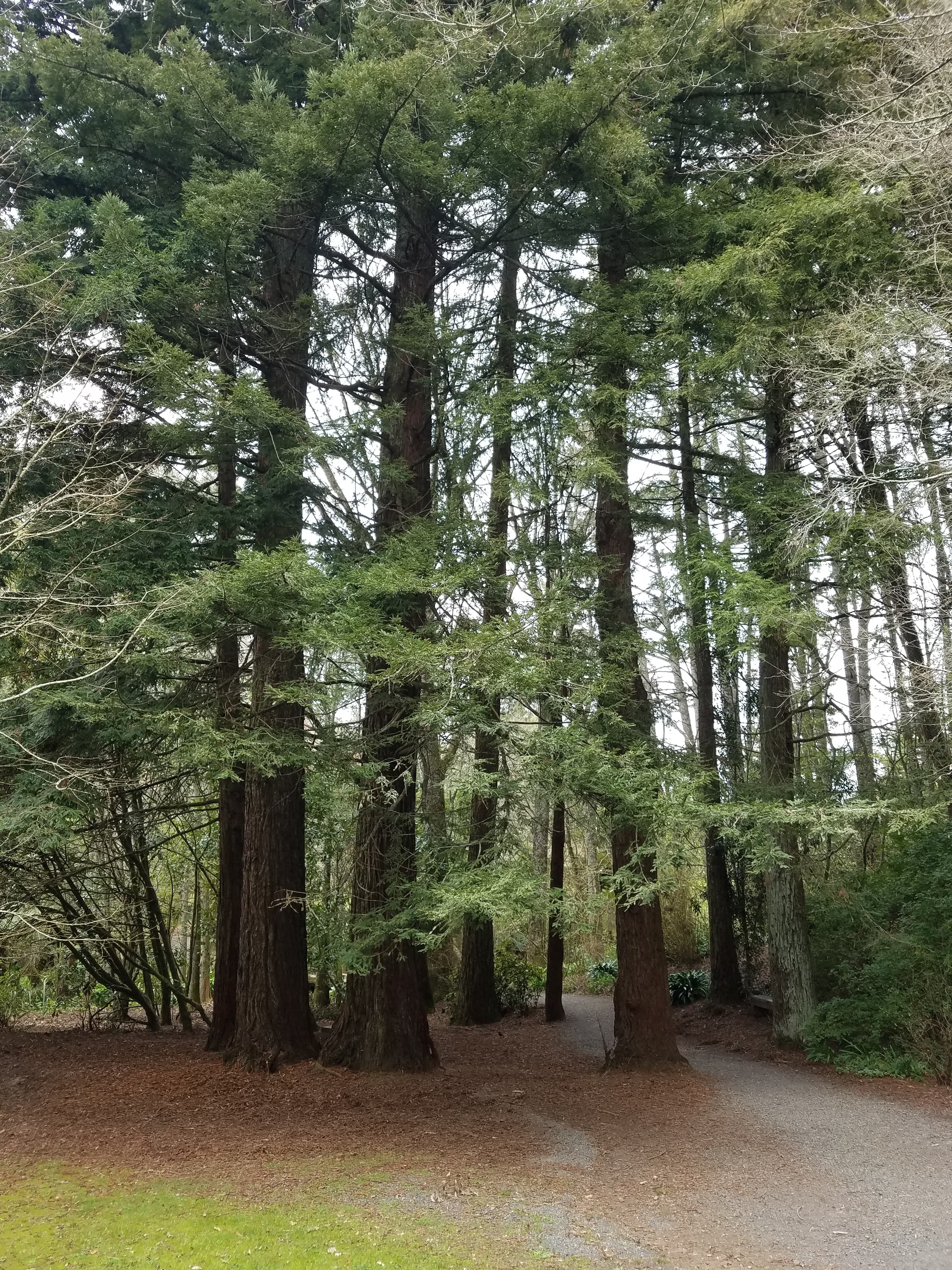
Different areas are devoted to different trees, such as a Native area, a Conifer area, an American area etc.  I especially loved this circle of redwoods.


Chickens roam freely around the place and there are signs up asking people to please only feed them certain items (which were listed).


These ducks were also interested in being feed, but there was nothing to be had and they soon returned to the pond.


Some of the lower areas of the Arboretum are rather swampy.  This was where I turned around and began the trek back up to the carpark, as my strength has not yet fully restored.


Parts of the area are still farmed.  These steers were waiting to be fed their daily hay (they could hear the tractor approaching, and there was lots of mooing going on).


There were native birds around also, but they were too far away or too fast for me to be able to photograph them - kingfishers, fantails, lots of tuis, and grey warblers, but the highlight was a New Zealand Falcon (Falco novaeseelandiae in Latin, or Karearea in Maori).

I heard the call first (which folklore says foretells rain when the weather is fine as it was today), and then was lucky enough to see it as it flew among the trees searching for prey.

This photo was accessed at https://www.dreamstime.com/photos-images/karearea.html


I have a sneaky suspicion I may have sore legs tomorrow 😊

Margaret.


Monday, 22 February 2021

Cicadas Mean Summer


I am not sure how I did it, but this morning I managed to spill a whole lot of milk down the front of my dressing gown.  Yuk!

Thankfully it was another hot sunny day, so the dressing gown is now all washed, dried, and hanging back up on its bedroom hook.


I had occasion to drive across town this morning and revelled in the smell of the eucalyptus gums down the road.  Because of the heat, they are releasing their scent in overload and it is an aroma that I adore.

Nature’s music was in overload too, with cicadas singing their hearts out in the trees.  They seem to prefer London Planes and English Oaks, but maybe that is because that is what most of our big city trees are.

I love seeing their empty shells sitting on the bark – as children we used to collect bucketsful of them.  I don’t really know why, as I don’t recall doing anything with them.  I think they just intrigued us.


It is the male cicadas that make all the noise, hoping to attract a female.  They only live 3-4 weeks, but that is long enough to mate and start the life cycle again. 

Grubs will burrow into the earth beneath the tree, and not re-emerge until several years later.  There are 42 species of cicada found in New Zealand, and there is still a lot that science does not know about them.


To us normal people, the loud cicadas mean late summer when the weather is hottest.  When they stop singing, then we can expect our weather to cool down.

Smile, and be happy 😊

Margaret.


Tuesday, 2 February 2021

Watermelon Weather


It looks like we are having a week of hot weather, with temperatures up in the late 20s Celsius.  It is perfect weather for eating watermelon!

I’m really fussy about pips and I remove each one before I eat.  Hubby used to stand out on the lawn and spit his pips over into the paddock, and I have a friend who crunches away on every seed (which annoys me no end!).


Tonight I watched my currently favourite TV programme again – Modern Dinosaurs.  This week they were looking at gigantism (with a lot of talk about evolution, which I don’t really believe in). 

On Little Barrier Island we saw snails as big as a man’s fist – cruel creatures which devour live earthworms by grinding them down as they slowly swallow them whole.


We also looked at giant wetas known as wetapunga by Maori, meaning God Of The Ugly Ones.  This huge insect (a female can weigh more than a sparrow) may look fierce but it is actually very gentle.

Originally, they were widespread throughout the mainland, but man’s arrival 800 years ago introduced rats and now they are only found on protected islands.


Throughout New Zealand’s waterways are found long-fin freshwater eels.  These nocturnal-feeding fish are believed to be the largest fresh water fish in the world and have been known to grow to over 2 metres long (which takes about 200 years!).

When the time is right these fish will swim off for the tropics to breed, after which they will die.


I may not ever see any of these creatures in real life, but I do enjoy watching documentaries about them.

Nature is certainly wonderful in all its aspects 😊

Margaret.


(Apart from the watermelon, photos were taken from the television programme mentioned above).


Tuesday, 29 September 2020

Whitebaiting


Whitebait season has begun!  It is the time of year for delicious whitebait fritters (basically fried fish and egg patties) – if you have access to this fishy delicacy!


Whitebait Fritter served with salad

New Zealand whitebait are the immature young of five different species of fish that make their way from the ocean and up the rivers in springtime.  They are caught with nets and popular fishing spots are often claimed by the same people each year.


Permanent whitebaiters' huts dotted along a riverbank in Southland

Patient whitebaiters can be found sitting alongside riverbanks or working the river mouths with their nets.

Catches are smaller than of old, and restrictions are now in place to regulate the health and abundance of the whitebait.


Netting whitebait at the mouth of the Kiritehere River


I was sent a gorgeous photo of a Royal Spoonbill feasting on whitebait on the edge of Waimakariri River in Canterbury, but unfortunately was denied permission to post it here.

This spoonbill photo was taken by Rebecca Bowater and sourced from www.nzbirdsonline.org.nz


Have an enjoyable week everyone 😊

Margaret.


Monday, 30 March 2020

Sea Lions at Waipapa Point


Waipapa Point is a great place to visit to see rugged coastline, sea mammals and an historic lighthouse, and is situated on the eastern side of The Catlins at the bottom of the South Island.

  
The wooden lighthouse has been in continuous operation since 1884, and became fully automated in 1976.


The New Zealand Sea Lion, endemic to New Zealand, occasionally comes ashore here to rest on the beach and in the coastal turf.  Fur Seals look similar and sometimes come ashore here, although they generally prefer a more rocky beach.  Sea Lions are much larger than seals and have a blunt snout and short whiskers, but are very similar in the colouring of their fur.

The snoozing sea lion on the beach here was a female, about half the size of an adult male who can grow up to 3.5 metres long and weigh up to 450kg.


As my husband and I walked up towards the lighthouse we were startled to see a large male sea lion waking from his sleep, hidden in the turf beside the path.  We prudently retreated up the hill to a safe distance and watched him.


The New Zealand Sea Lion, known as Rapoka in Maori, is one of the rarest sea lions in the world.  It is a species currently in decline and is fully protected by law.

If you ever come across one, feel privileged but be warned that they can chase you and deliver a nasty bite.  Do not disturb or frighten them and stay at least 10 metres away, or more if you have a dog with you.  Never run away from a close encounter, but back off slowly and avoid direct eye contact.


The male we were observing took his time to wake up.  He stretched and yawned and rolled around a bit, before slowly lumbering across the turf and down onto the beach.


Once on the beach he began flipping sand up over himself.  He must have done this for several minutes, in a slow and calculated manner, before finally sprawling out motionless on the sand and beginning another snooze session.

It is generally thought sea lions, along with other similar species, flip sand over themselves as a way of keeping cooler, of protecting themselves from the sun.


We felt very honoured to have witnessed this male and female sea lion in the wild, and left them sleeping just metres apart from each other.

They were living their lives doing what sea lions have always done.  They were not worried about where their next meal was coming from, or the fact that their species is under threat.  They were appreciating and enjoying the moment.

Whatever crises mankind faces, time passes and life continues.  Nature carries on like it has always done – the tide comes in and the tide goes out, birds build nests in springtime, and the sun shines every day (even when we cannot see it!).  We can learn so much from our observations of Nature.


As we left Waipapa Point I stopped and photographed these trees.  The wind down here can be extremely fierce at times and I believe it blows on most days.  We were fortunate on the day we visited as there was no wind and it was sunny.


Never give up hope, look for good things in your life and be thankful for them.
Margaret.


LINKING UP WITH Saturday's Critters


Wednesday, 4 March 2020

Ruapuke Beach, Raglan


Ruapuke Beach is a wild remote black-sand beach that is dangerous for swimmers but popular with surfcasting fishermen and experienced surfers, and is located between Raglan and Kawhia on the west coast of the Waikato district. 

The last time we visited here (2007), the only access road was gravel.  These narrow roads, with their twists and bends and dips and hollows, were often used by international car rallies but I believe the road has now been tar-sealed, at least between Raglan and Ruapuke.


At the Raglan end of the beach we found these cave formations along the rocky embankment here.  They were not ‘proper’ caves as they did not go into the bank very deeply – they were just exciting enough for children to play pirates in!


We saw very few shells along the beach, except for pockets of Rams Horns that had been washed up after a recent storm.  A woman was busy collecting them – she had so many that we suspected she was maybe hoping to sell them.


Washed-up Blue Bottle Jellyfish, also known as Portuguese Man-of-War, were plentiful along the beach on the day we visited.    These marine creatures (they are technically not jellyfish) have long venomous tentacles that can deliver a very painful sting (even after being beached), and are responsible for the majority of ‘jellyfish’ stings along our coastlines.


It was low tide by the time we left Ruapuke.  We were alone on the beach, and spent a magical moment standing quietly in awe of the untamed wild beauty of this place.  I can still smell the tang of the ocean waves and hear the sound of the wind.  Some things are just imprinted in your memory forever.


At home today, we woke this morning to rain!  A light steady fall of rain which was great for the garden.  The sun is shining again now, in the afternoon, but there are still rain clouds around.  We are currently under a thunderstorm watch, so we shall see what the rest of the day brings.

Margaret.


LINKED TO My Corner of the World and Skywatch Friday